
Motion Blur vs Ghosting: What’s the Difference?
Understand motion blur, ghosting, inverse ghosting and pixel response behavior, then learn how to test them correctly in your browser.
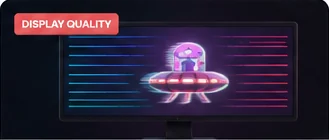
Motion blur and ghosting are often described as the same thing, but they are different visual effects. Separating them makes it easier to choose the right setting or decide whether a display response problem is actually present.
Motion blur
Motion blur is a loss of detail while an object moves. Some blur comes from the way sample-and-hold displays present frames, some comes from pixel response time, and some can come from the source content itself.
Ghosting
Ghosting is a visible trail behind or around a moving object. It is easiest to see when a high-contrast target moves across a flat background. Gray-to-gray transitions can reveal behavior that black-to-white motion does not.
Inverse ghosting
Overdrive can make pixels change faster, but too much overdrive may overshoot the intended level and create a bright or dark halo. This is commonly called inverse ghosting or overshoot.
How to compare displays or settings
- Use the same browser and zoom level.
- Run the same target speed.
- Compare standard and gaming/overdrive modes.
- Keep brightness reasonably similar.
- Watch the moving target itself, not only the background.
What to look for
A clean result keeps edges recognizable during motion. A mild trail may be normal for a slower transition. A strong repeated shadow, colored halo or obvious overshoot is more useful evidence of response behavior.
Refresh rate matters too
Higher refresh rates can make motion appear smoother and reduce the distance an object travels between updates, but refresh rate alone does not guarantee fast pixel response. A high-Hz panel can still ghost if its transitions are slow.
Do not judge a display from a single photograph of a moving test because camera shutter speed can add its own blur. The most useful comparison is what your eyes see repeatedly under the same conditions. If a trail remains visible across several target colors and speeds, it is more likely to reflect the display’s motion behavior.
- Run the same pattern and speed for each overdrive mode.
- Watch both the leading and trailing edges of the moving target.
- Prefer the setting that reduces blur without creating obvious bright or dark halos.
- Repeat at the refresh rate you actually use, because the best setting can change with refresh rate.
How to compare monitor overdrive settings
A panel may handle black-to-white motion well but struggle with certain gray-to-gray changes. That is why a useful test should include light, dark, gray and colored moving targets rather than only one rectangle. Small text, fine lines and checker patterns make smearing easier to notice because they lose detail quickly when response behavior is poor.
Why different transitions matter
Motion blur is the general loss of sharpness you perceive while an object moves. Ghosting usually appears as a visible trail behind that object because pixel transitions do not complete quickly enough. Inverse ghosting, sometimes called overshoot, can create a bright or dark halo on the opposite side of a moving edge when an aggressive overdrive setting pushes the transition too far.
Blur, ghosting and inverse ghosting look different
Related tests and guides
Remember: browser diagnostics are observational tools. They can reveal repeatable visual symptoms, but they do not replace laboratory measurement or a technician when hardware diagnosis is required.